Walk into any trade show in Dallas, any Little League field in Ohio, any coffee roaster in Portland, and you’ll see the same thing on people’s heads: a baseball cap with a logo on it. It’s the most worn piece of branded apparel in the country, and it has been for decades.
But here’s what most people ordering merch never stop to think about, the number of fabric panels stitched into that crown changes how your logo sits, how big it can be, and how the whole hat reads on a person.
That’s the real question behind 6 panel vs 5 panel hats. It isn’t a style debate. It’s a branding decision that gets made before a single stitch goes down.
Below, we’ll break down the construction differences, the embroidery space each one gives you, which industries lean toward which, and how to pick the right one for your next run of custom baseball hats.
What the Panels Actually are?
The crown of a cap is made from separate pieces of fabric sewn together. Those pieces are panels. Count the seams and you’ll know what you’re holding.
The 6 panel vs 5 panel hats difference lives entirely in that front construction, and that’s enough to interpret your whole decision. At The Custom Hats Maker we manufacture according to your requirements and design styles
The 6 Panel Build
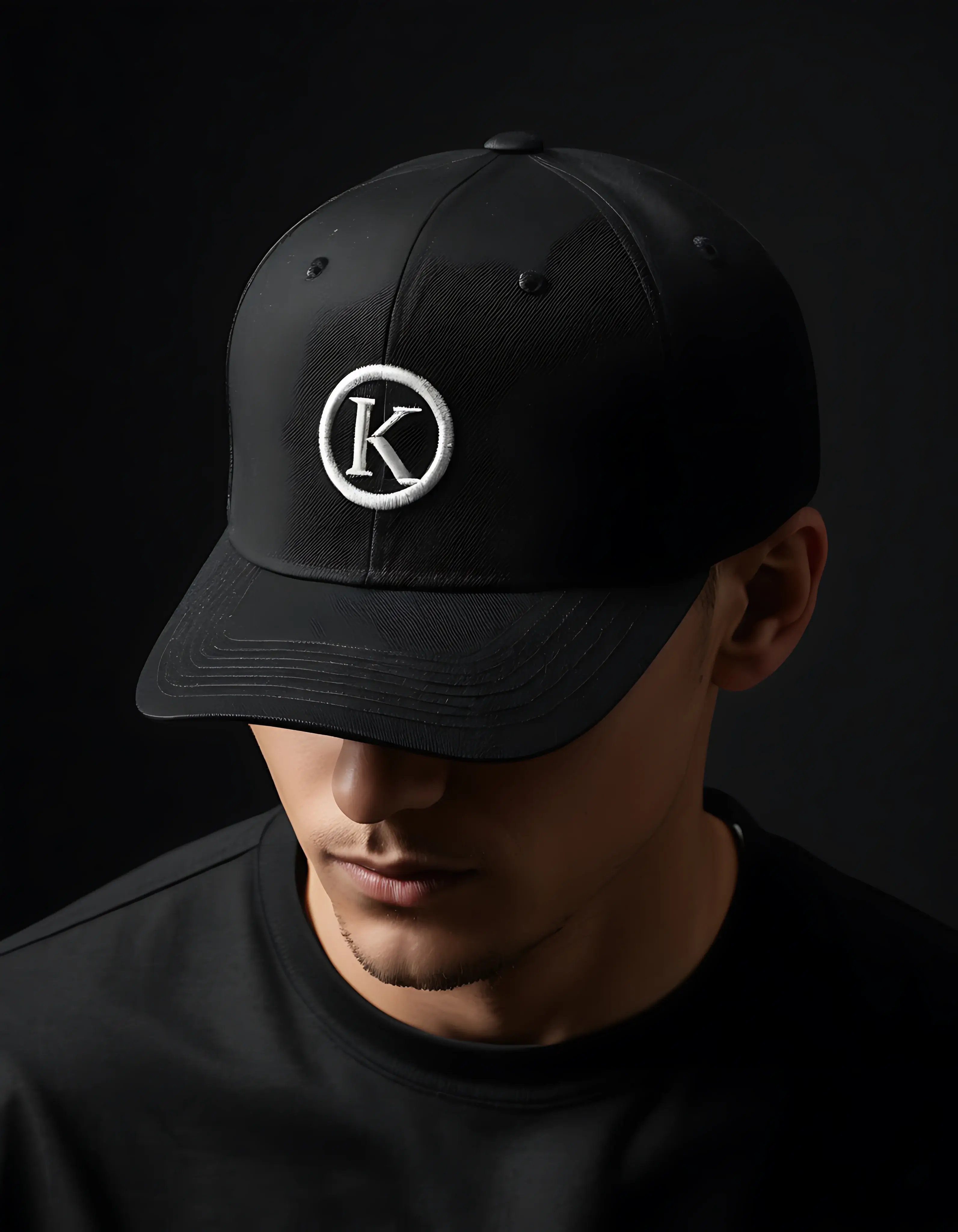
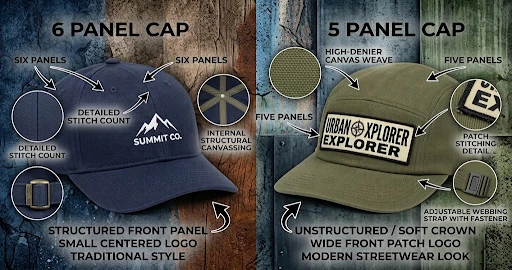
A 6 panel cap has six pieces, two in front, two on the sides, two in back, joined by a vertical center seam running straight up the middle of the forehead. This is the classic American baseball silhouette.
It’s what MLB teams wear. It’s about that time period when your dad wore it, known as dad hats. The center seam is the defining feature, and it’s exactly where things get interesting for branding.
The 5 Panel Build
A 5 panel cap replaces those two front pieces with one continuous panel. No center seam. You get a smooth, uninterrupted face across the front of the crown, with the remaining four panels handling the sides and back.
The profile sits a little flatter and reads more modern, it’s the shape you see on camp caps, skate brands, and streetwear drops.
The Seam Problem Nobody Warns You About
On a 6-panel cap, that center seam sits right where you’d naturally want your logo. Machines can stitch over a seam, technically, but there’s a ridge under the needle, not flat fabric like you’d get elsewhere.
Get too dense with the stitching there and things start to pucker, pull, sometimes split right down the middle of the design.
Logos get centered so the seam falls in a neutral spot, or designs get shifted to the left front panel, or stitch density gets adjusted. It’s routine, it’s why a cheap supplier and a careful one produce visibly different results from the same artwork file.
A 5 panel cap has no such ridge and you get a clean canvas across the whole front. Large embroidery, woven patches, leather patches, wide wordmarks, all of it sits flat.
If your logo is horizontal, detailed, or just plain big, this is a real advantage. That single fact drives most of the 6 panel vs 5 panel hats conversation among people who order branded headwear regularly. Depicting the fact about the purpose of each hat type.
6 Panel vs 5 Panel Hats: Side-by-Side Comparison
| Feature | 6 Panel Cap | 5 Panel Cap |
| Front construction | Two panels, center seam | One continuous panel, no seam |
| Crown profile | Structured, taller, rounded | Flatter, lower, squared off |
| Best logo shape | Compact, centered, vertical-friendly | Wide, horizontal, oversized |
| Patch friendliness | Good for small patches | Excellent for large patches |
| Brand feel | Traditional, sporty, dependable | Modern, casual, design-forward |
| Typical audience | Teams, corporate, schools, trades | Lifestyle brands, cafés, festivals, creatives |
| Fit range | Very wide — the safest bulk choice | Slightly narrower appeal |
| Embroidery complexity | Needs seam-aware placement | Straightforward placement |
| Resale as merch | Reliable, easy to move | Higher perceived style value |
How to Use a 6 Panel Cap Effectively?
If you’re ordering 200 hats for a construction company, a school fundraiser, a dealership, or a regional sales team, this is almost always the right call. It fits a broad range of head shapes, it reads as familiar rather than fashionable, and nobody feels awkward wearing one.
Getting the Front Logo Right
Keep your front logo tight and vertical-leaning. A stacked wordmark, a monogram, a shield, a circular badge, these all sit beautifully on a 6 panel because they respect the center seam instead of fighting it.
Aim for roughly 2 to 2.5 inches wide on the front and let the design breathe. Logos built around a vertical axis naturally fall on either side of it without looking cut.
Trying to squeeze a wide design across the seam is the single most common reason branded caps come out looking slightly off.
Using the Side, Back, and Visor Space
Then use the rest of the hat and the side panels take a small secondary mark, an established year, a state outline, or a department name. The back, above the closure, holds a URL or a short tagline.
Spread across four small placements, a 6 panel cap tells a fuller brand story than a single oversized front logo ever could, and it looks intentional rather than loud.
Structured custom baseball hats in a 6 panel build also hold their shape through washing and daily wear.
How to Use a 5 Panel Cap Effectively?
The 5 panel rewards boldness. That open front panel is the whole point, so don’t put a two-inch logo in the middle of it and call it done. Making this build work well means thinking in terms of scale and matching it to the right kind of brand.
Sizing Your Logo for the Open Front Panel
Horizontal wordmarks work exceptionally well here, often running 3.5 to 4.5 inches across. Large woven patches, rectangular leather patches, and full-front illustrations all sit flat and clean.
Brands that want their name readable from across a room should be considering this option. A logo sized for a business card will look lost on this much open fabric, so treat the front panel like a small billboard rather than a name tag.
If your brand has a full wordmark you rarely get to use at size, this is the placement that fits accurately.
Matching the 5 Panel to the Right Brand Aesthetic
The flatter crown also pairs naturally with certain aesthetics. Outdoor and camp-inspired branding, coffee shops, breweries, music merch, design studios, skate and surf labels, these all tend to look right in a 5 panel.
The hat itself communicates something before anyone reads the logo. A brand with an established visual identity will look more at home in a 5 panel than in a traditional structured crown.
It’s worth asking whether your brand already “looks” like this hat before you order it, because the shape itself carries a message independent of whatever logo sits on top of it.
Applications by Industry:
| Use Case | Recommended Build |
| Corporate staff uniforms | 6 panel |
| Construction and trades | 6 panel |
| School and college merch | 6 panel |
| Youth and adult sports teams | 6 panel |
| Coffee shops and breweries | 5 panel |
| Streetwear and apparel drops | 5 panel |
| Music and artist merch | 5 panel |
| Trade shows and conferences | 6 panel |
| Outdoor and adventure brands | 5 panel |
| Nonprofits and charity runs | 6 panel |
| Real estate and dealerships | 6 panel |
| Festivals and summer events | 5 panel |
Which One Should You Choose? 6 Panel or 5 Panel?
It comes down to three things: your logo, your people, and where the hat actually ends up living after launch day.
-
Start With Your Logo, Not Your Taste
Wide logo, lots of detail, something people need to read from across a room, that’s a 5-panel job. It gives the design space to breathe instead of getting crammed down to fit.
Compact or badge-shaped logo? Go 6-panel. The bonus you also get the sides and back to play with, not just one front panel.
Quickest way to settle it, print the logo at real size, hold it against a 2-inch box, then a 4-inch one. You’ll know instantly.
-
Think About Who’s Actually Wearing It
Then look at who’s wearing it, because a hat that half your team leaves in a drawer is money spent for nothing.
For mixed-age, mixed-preference groups, company-wide orders, school programs, volunteer events, anything where you can’t predict everyone’s style, 6 panel is the lower-risk option almost every time.
For a defined audience that already buys into a certain aesthetic, the 5 panel earns its place and often gets worn more.
-
Consider Where the Hat Lives After It’s Handed Out
Merch you’re actually selling benefits from the style edge of a 5 panel, people buy into a look, not just a logo. Workwear and giveaways benefit from the durability and neutrality of a 6 panel, since it needs to work for whoever ends up wearing it, not just the person who picked it out.
Plenty of brands eventually run both, a 6 panel for staff and promos, a 5 panel for retail.
That’s a perfectly reasonable answer to 6 panel vs 5 panel hats, and it’s more common than you’d think once a brand has more than one type of hat-wearing audience to serve.
Why Work With Custom Hats Maker?
Custom Hats Maker builds headwear for brands, teams, schools, events, and apparel labels. Pick your style, send your design, and get hats made for real wear rather than just product photos.
You should also look into the custom hats guide for getting to know more about styles and branding. Important factors to consider while choosing Custom Hats Maker are listed below:
Fit and Construction Comes First
If your logo’s wide or has a lot of detail, go 5-panel. You get the room to actually show it off instead of shrinking it down to fit.
The 6-panel makes more sense for something compact or badge-shaped, plus you’ve got the sides and back to work with, which the 5-panel doesn’t really give you.
Not sure which one you’ve got? Print the logo at real size, then hold it up next to a 2-inch box and a 4-inch box. It’s usually obvious right away.
Decoration Options are Genuinely Flexible
Embroidery, printing, and patches are all on the table, and placement guidance is part of the service rather than something you have to figure out alone.
That matters especially for 6 panel orders, where seam-aware logo positioning is the difference between crisp and puckered.
It also matters for 5 panel orders, where getting the scale of a wide logo right takes a trained eye. Whichever decoration method fits your brand and budget, the team helps you land on placement that actually works on fabric, not just on screen.
The Style Range is Wide
Baseball, trucker, snapback, fitted, dad, bucket, flat, golf, sports, and embroidered hats all sit under one roof, so you can build a full merch line without juggling three vendors. That’s useful for brands that need more than one silhouette.
Having every style available in one place also keeps fabric, thread color, and branding consistent across an entire product line.
One vendor, one quality standard, no guesswork stitched between orders.
Bulk is the Norm, Not the Exception
Whether it’s 25 hats for a charity 5K or 500 for a trade show, the process is built for volume with consistent output across the run.
That consistency matters more than people expect, a hat that looks perfect as a sample but drifts in quality by unit 300 isn’t actually a finished product.
Pricing and turnaround scale sensibly with quantity, so a larger order doesn’t mean a longer wait or a rushed result. It’s built for real organizational needs, not one-off gifts.
Support Stays Responsive
Customers keep bringing up two things, fast turnaround and actually being kept in the loop.
If you’ve ever chased down a merch order two weeks before an event, you know what that’s worth. Ask about placement, sizing, fabric, you get an answer.
That’s usually what separates a smooth order from a stressful one, especially when the deadline isn’t moving. Trade show, season kickoff, the date’s fixed either way.
Tips and Common Corrections
- Send vector artwork. AI, EPS, or PDF files stitch cleanly. A JPG pulled off a website will look rough once it’s thread.
- Simplify before you embroider. Gradients, thin strokes under 1mm, and tiny text below 0.2 inches don’t survive the needle. Reduce detail deliberately instead of hoping for the best.
- Center your logo on a 6 panel. Off-center designs collide with the seam and pull unevenly.
- Go bigger than feels natural on a 5 panel. Undersized logos on an open front panel look like a mistake.
- Account for fabric color. Light thread on dark fabric may need underlay to stay crisp. Flag it early.
- Don’t overload one hat. The front, one side, and back are plenty. Every additional placement dilutes the others.
Frequently Asked Questions
Do 5 panel caps fit differently?
They sit a little flatter and lower, but the fit range is comparable.
Which is more popular in the USA?
6 panel, by a wide margin, it’s the traditional baseball silhouette.
Can I put a large patch on a 6 panel cap?
Yes, but the center seam limits how wide you can comfortably go.
Are 5 panel caps more expensive?
Pricing is generally similar; decoration and quantity drive cost more than panel count.
Which one lasts longer?
Both hold up equally well when built with quality fabric and stitching.
Can I order both styles together?
Yes, running both is common for brands separating staff wear from retail merch.
How many hats is a typical minimum order?
Bulk runs are standard, request a quote to us for your specific quantity.
Do structured caps hold shape after washing?
Yes, structured 6 panel crowns keep their form with normal care.
Picking the Right Cap for Your Brand
There’s no universal winner in 6 panel vs 5 panel hats. There’s only the right fit for your logo, your audience, and where the hat ends up living.
The 6 panel is the dependable American classic that almost everyone will wear. The 5 panel is the design-forward option that makes a bold mark land harder.
Get that choice right and your custom baseball hats stop being giveaway clutter and start being something people reach for on purpose. That’s the whole goal, and it starts with knowing what those panels are actually doing.
Ready to move? Head to The Custom Hats Maker, pick your style, and request a free quote.